
The year 2025 was a fever dream, a relentless climb toward a singular, dazzling peak that fashion warriors across the globe had marked on their bespoke calendars with glittering ink. And then, like a meteor composed entirely of silk, starlight, and audacious tailoring, it struck. December 2025 didn't just arrive; it crash-landed straight into the hearts of every stylist in Miraland, detonating an explosion of ecstasy called Infinity Nikki 2.0. The wait was agonizing, a delicious torture orchestrated by Infold Games with surgical precision. Patch 1.8 had whispered sweet nothings of Danqing Island in July, a mere appetizer of ink-woven tales that left everyone starving for the main course. Then came the domestic bliss of 1.9's Home spaces, the cryptic silence of 1.10 that drove theorists absolutely feral, and the revolutionary garment-dyeing laboratory of 1.11. Each update was a breadcrumb, a sparkling, manicured crumb leading to a feast so colossal that the servers nearly melted from the sheer collective intake of breath when the 2.0 gates finally swung open on the game's stunning one-year anniversary.
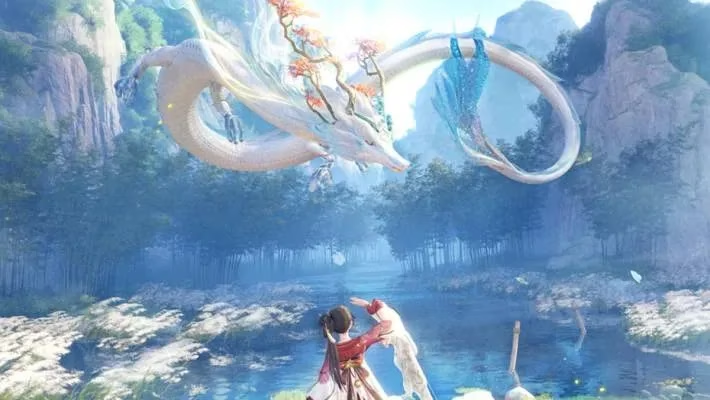
The update didn't just add content; it performed a full-blown magical girl transformation on the very concept of a live-service game. Forget everything you thought you knew about whimsical exploration—Elderwood Forest and Spira City emerged not as simple maps, but as living, breathing catwalks ruled by ancient spirits and cyberpunk street-style deities. One moment players were navigating the twisted, luminous roots of an enchanted woodland where every leaf rustled with forgotten ballads; the next, they were ziplining through a towering metropolis where holographic billboards displayed the latest five-star ensembles in glorious real-time. The tone shift was so audacious, so impossibly chic, that it caused widespread fashion whiplash, a condition for which the only cure was to immediately change outfits nine times in an hour. And as if that wasn't enough, movement itself was reinvented. Why run when you can drift down a crystal-clear river on a jaunty little raft, posing for screenshots as the sun dapples through the canopy? Why walk when you can mount a gigantic, glamorous snail, a living vehicle so decadently slow and fabulous that it gave prompt-based 'fits an entirely new rhythm of existence? The rideable raft and snail weren't just gimmicks; they were philosophical statements about the intersection of leisure and high fashion.
The wardrobe, that sacred vault of digital drip, underwent a metamorphosis so profound it required its own set of safety warnings. The introduction of individual clothing piece dyeing from patch 1.11 was a powder keg, but 2.0 lit the match. The ability to customize every single ribbon, sock, and glove sent the creative community into a supernova of chromatic obsession. Suddenly, owning a five-star outfit wasn't the endgame; mutating it into a thousand personally-tuned variants was. Players who had once strutted with confidence now wept openly in the new Home spaces, their kitchens—yes, kitchens!—filled with the aroma of freshly baked virtual pastries as they agonized over whether to dye the Clouded Loong set's tail a muted celeste or a searing vermillion. The long-awaited cooking feature, which piggybacked on the housing system, turned Miraland into a frenzied episode of a gourmet competition show, where the ultimate accessory was a perfectly plated fantasy feast. Outfit grouping in the wardrobe finally brought a semblance of order to the chaos, allowing stylists to organize their digital empires with a flick of the wrist, a silent prayer answered after a year of frantic guesswork.
And the outfits! Oh, the outfits that emerged from this creative crucible were nothing short of reality-bending. The five-star Forever Bond and Clouded Loong sets from the Danqing Season were already considered holy relics, but then the development team, in a fit of divine madness, introduced "mix-and-match" pieces explicitly designed to break the established laws of sartorial physics. A sleeve from a fairy-tale gown could now fuse seamlessly with a cyberpunk bolero, all because the developers decided to add alternate detail options for older five-star banners. The Yin Yuan outfit, that generous free four-star gift, was retroactively elevated to icon status as crafty players realized its base fabric took dyes with an almost luminous, otherworldly glow. The Bibcoon’s Chuckle Club quests from patch 1.9, once completed, had seeded the land with bizarre, whimsical props that now found their way into the most avant-garde photo shoots, staged against the bioluminescent backdrop of the Elderwood or the rain-slicked asphalt of Spira City. The lore, which had been simmering quietly, suddenly erupted. The main story quest's return in 2.0 didn't just tie up loose ends; it unraveled the entire tapestry of Miraland and wove it back together with threads of starlight and shadow, leaving theorists scouring every decimated ruin and neon alley for clues about a future that suddenly seemed terrifyingly vast.
The Miraland Round Table had hinted at these miracles, but their words were a gentle breeze compared to the hurricane that arrived. The promise of "more mix-and-match pieces" was a criminal understatement; it was a full-scale liberation of form. General bug fixes were expected, but the performance overhaul that accompanied 2.0 made the game run so smoothly on mobile devices that it felt like witchcraft. The Spira City streets didn't just look wet; they reflected every individual sequin on a player's custom-dyed jacket with ray-traced perfection that caused PS5 consoles to hum a serene, satisfied melody. The community, united by a year of shared anticipation, transformed overnight. Guides for snail drift-racing emerged. Recipe books for in-game cooking became best-sellers in real-life fan zines. A black market for rare dye ingredients almost crashed the in-game economy. The 1.0 launch anniversary celebration was less a party and more a planetary alignment, a moment where every single element Infold Games had hinted at coalesced into an experience so overwhelmingly stylish that it redefined the cozy open-world genre entirely. Even now, deep into 2026, the ripples haven't stopped. They’ve become tidal waves of pure, unrelenting glamour.
Comments